



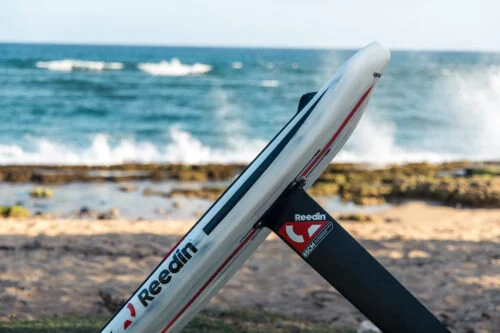
Unsure how many liters your wing foil board should have? Choosing the wrong gear can turn your learning experience into a frustrating struggle, but the right volume and shape will have you gliding over the water much sooner than you think.
Beginners: Prioritize Stability and Buoyancy
When selecting your first board, the most critical specification is volume, measured in liters. As a beginner, you need enough buoyancy to stand comfortably on the board even before you gain enough speed to fly. A reliable rule of thumb is to choose a board with a volume equal to your body weight in kilograms plus 20 to 40 liters. For example, an 80 kg rider should look for a 100L to 120L board; this provides a stable platform that forgives balance errors and builds confidence.
What Size Wing Foil Board Is Right for Me?
Larger boards are typically wider, providing the necessary stability to practice taxiing and your first take-offs. The Reedin FEATHER S is designed specifically for beginners and schools, offering the perfect balance of stability and enough glide to get moving. Its “softtop” deck makes falls safer and is much more comfortable for your knees and feet. Alternatively, the inflatable iFeather is an excellent choice for the traveling surfer, offering maximum buoyancy and portability without sacrificing too much performance.
Intermediate: Transitioning to Maneuverability
Once you’ve mastered stable flights and are ready to tackle more complex maneuvers like tacks or jibes, it’s time to move to a smaller board. Intermediate riders usually prefer boards with a volume roughly equal to their body weight (within a +/- 10-liter range). A smaller board is less sensitive to wind gusts while in the air, reacts faster to foot pressure, and provides a more dynamic, connected riding experience.
The Reedin Controller is designed for those ready to graduate from a beginner board to a more compact design. It incorporates the high-performance lessons learned from the Feather series into a more accessible package. Its slightly wider outline ensures early planing and easy starts, while remaining stable when “taxiing” on the surface. Remember that equipment synergy is key; the right wing size and wind conditions will determine how effectively your board breaks free from the water.
Advanced: Compactness and Precision
Advanced riders seek maximum performance, which often means riding “sinker” boards with a volume 15–40 liters less than their body weight. These boards sit partially submerged when stationary and require proficient pumping techniques and sufficient wind to get onto the foil. At this level, construction is paramount—the full-carbon FEATHER LW, for instance, weighs only about 6.5 kg, ensuring maximum stiffness and a direct, instantaneous connection to the foil.
For the ultimate experience, the Feather 4 features an ultra-compact outline that minimizes aerodynamic drag and offers total control during jumps and sharp turns. Experienced riders often pair these boards with longer masts to clear larger waves without the nose of the board catching the water. You can learn more about how mast length affects the riding experience and maneuverability in our dedicated guide.
The Impact of Shape and Construction
A board’s “outline” (its shape) determines how quickly you reach take-off speed and how forgiving it is during touchdowns. While a wider board offers stability during the learning phase, it creates more aerodynamic drag once you’re in the air. Conversely, the long, narrow shape of the LW series significantly reduces water resistance, making it an essential tool for light-wind sessions. Additionally, a rockered or beveled nose helps prevent “nose-dives” by bouncing the board back into the air if it touches the water.
Unlike kitesurfing, where boards are thin, wing foiling requires a robust internal structure to withstand the high torque forces generated by the foil mast. All Reedin foil boards are built to last, utilizing modern materials that ensure lightness without sacrificing durability.
Choosing the right board starts with an honest assessment of your skills and local conditions. As a beginner, always lean toward a larger, more stable model like the FEATHER S to ensure fast progress. As you advance, you can move toward the total freedom offered by compact carbon boards. To explore the full range, browse our wing collection foil boards and find your next companion for the water.
 No products in the basket.